Why Do I Keep Responding the Same Way?: Romans 12:1–2 and the Renewal of the Mind in Christ

Deep ruts in an old road remind us how quickly the mind can return to familiar meanings and responses. Yet the pattern is not our identity. By the mercies of God, the Spirit renews our minds and teaches us to live from Christ in what happens next.
A familiar moment can produce a familiar response with surprising speed.
I can be sitting at dinner with friends, telling a story to make a particular point. Someone interrupts to correct a detail that has little to do with the point of the story. Perhaps I mentioned the wrong place, date, or order of events.
The correction may even be accurate.
But from where I am sitting, it breaks the flow of the story. Before I have had time to consider what happened, frustration rises and a familiar thought appears:
“Why do they always do this?”
Perhaps the interruption really was unnecessary. There may be a legitimate concern worth addressing later. But the fact that the concern is legitimate does not settle the question of how I will respond to it.
Why does this kind of moment produce the same conclusion so quickly?
Why does the frustration follow the same route?
Why do I feel such a strong need for the other person to understand the event exactly as I understand it?
Romans 12 gives us a place to begin.
Paul writes:
“Do not be conformed to this world, but be transformed by the renewal of your mind.”
Romans 12:2
The answer is not simply stronger restraint, better social skills, or replacing one phrase in my mind with a more positive phrase. Paul is describing a life being transformed from the inside out as the mind is renewed under the mercies of God.
A familiar event may still activate a familiar interpretation. The flesh may still reach for an old response. But the pattern does not define who I am in Christ, and it does not have to determine what I do next.
Part One: The Theological Exposition
This Is Who You Are in Christ
Renewal begins with mercy
Romans 12 begins with one of the most important words in Paul’s letters:
“Therefore.”
Paul has spent eleven chapters unfolding the mercies of God.
Humanity stands guilty before God.
No one can establish righteousness through works of the law.
God has revealed His righteousness in Jesus Christ.
Sinners are justified through faith.
Christ died for the ungodly.
Believers have peace with God.
They have been united with Christ in His death and resurrection.
Sin’s dominion has been broken.
There is now no condemnation for those who are in Christ Jesus.
The Spirit dwells within them.
They have received adoption and cry, “Abba! Father!”
Nothing can separate them from the love of God in Christ.
Then Paul says:
“I appeal to you therefore, brothers, by the mercies of God.”
The order matters.
Paul does not say:
Transform yourselves, and then God will show you mercy.
He says:
God has shown you mercy in Christ. Therefore, present yourselves to Him.
Mercy comes before transformation.
Grace comes before obedience.
Union comes before fruit.
The believer does not pursue renewal in order to become acceptable to God. He pursues renewal from the secure place of already being accepted in Christ.
That protects Romans 12 from becoming another program of religious self-improvement.
You are not trying to build a new identity through better responses.
God has already brought you into Christ.
You are learning to live from the identity, life, and mercy you have received in Him.
Present your bodies as a living sacrifice
Paul continues:
“Present your bodies as a living sacrifice, holy and acceptable to God, which is your spiritual worship.”
The language comes from the world of temple sacrifice, but the offering is now living.
The believer’s entire embodied life is presented to God.
The body is not a distraction from the spiritual life. It is where obedience becomes visible.
The face that wants to show irritation.
The eyes that may roll.
The voice that wants to become sharp.
The tongue preparing a defensive reply.
The body that wants to withdraw from the conversation.
The hands, posture, tone, and next action all belong to God.
Paul is not asking believers to despise their bodies. He is asking them to place their embodied lives at God’s disposal.
The phrase translated “spiritual worship” can also carry the sense of reasonable or fitting worship. In view of everything God has done in Christ, the fitting response is not a brief religious moment separated from ordinary life. It is the whole person yielded to God.
The dinner conversation becomes part of worship.
The private discussion afterward becomes part of worship.
The unresolved frustration becomes part of worship.
Not because frustration is holy, but because even that moment can be brought under the lordship of Christ.
The pressure of the present age
Paul says:
“Do not be conformed to this world.”
The word translated “world” refers here to the present age, the pattern of life organized apart from God.
This age trains people to live from self as the source.
Protect your reputation.
Control the outcome.
Make certain you are understood.
Defend your version of events.
Use withdrawal to punish.
Use anger to regain power.
Make another person’s agreement the condition of your peace.
These patterns can become so familiar that they feel natural and unavoidable.
But the Christian has been transferred into a new realm. He belongs to Christ. The present age no longer possesses the right to press him into its pattern.
Paul does not tell believers merely to resist outward pressure. He calls them to transformation through the renewal of the mind.
“Be transformed”
The command “be transformed” is significant.
Paul commands a real response, but the form of the word also points beyond self-generated change. The believer is not the independent creator of transformation.
God is the transforming One.
Second Corinthians 3:18 says believers are being transformed into the image of Christ by the Lord who is the Spirit. Philippians 2:13 says God works within His people both to will and to work for His good pleasure.
The believer participates.
He presents himself.
He receives the Word.
He turns from sin.
He speaks, chooses, listens, apologizes, and acts.
But he does not treat himself as the source of the life, wisdom, patience, and love required for those actions.
God transforms.
The believer responds in faith.
This is the abiding-life pattern.
Christ is the Vine.
We are the branches.
The branch really bears fruit, but the life of the fruit comes from the Vine.
What Paul means by the mind
The renewal of the mind is larger than changing a few sentences we say to ourselves.
In Scripture, the mind involves understanding, moral perception, judgment, interpretation, intention, and discernment. It is part of the whole inner orientation by which we understand God, ourselves, other people, and the situation before us.
That is why Paul immediately connects renewal with discernment:
“That by testing you may discern what is the will of God, what is good and acceptable and perfect.”
The renewed mind learns to recognize what pleases God in the concrete circumstances of life.
What does truth require here?
What does love require?
What belongs to me?
What am I trying to control that belongs to God?
What interpretation have I assigned to the other person’s conduct?
Have I treated my interpretation as though it were the only possible one?
Is my request reasonable, or has it become a demand that the other person must satisfy before I can become settled?
Renewal is not merely learning to think pleasant thoughts.
It is learning to see the whole moment under the truth, mercy, and lordship of God.
Romans 12 is deeply relational
Romans 12:1–2 is sometimes treated as an isolated teaching about private thought life. But the rest of the chapter shows what a renewed mind looks like among God’s people.
Paul immediately speaks about sober judgment, humility, and life together as one body.
He calls believers to genuine love.
He tells them to honor one another.
He commands them to bless those who persecute them.
He says:
“Live in harmony with one another. Do not be haughty, but associate with the lowly. Never be wise in your own sight.”
Then:
“If possible, so far as it depends on you, live peaceably with all.”
That final statement is especially important in relational conflict.
Paul recognizes that peace does not depend entirely on one person.
You can speak honestly.
You can listen carefully.
You can confess your own sin.
You can make a reasonable request.
You can refuse retaliation.
You can entrust yourself to God.
But you cannot produce understanding, agreement, repentance, or change inside another person.
“So far as it depends on you” establishes both responsibility and limitation.
You are responsible for your response.
You are not sovereign over theirs.
That is one of the freedoms of the renewed mind.
The Wheel Diagram as a counseling aid
In the video, I mentioned the Wheel Diagram developed by Dr. Charles Solomon and used within the exchanged-life counseling ministry of Grace Fellowship International. I learned to use it through Dr. John Woodward.
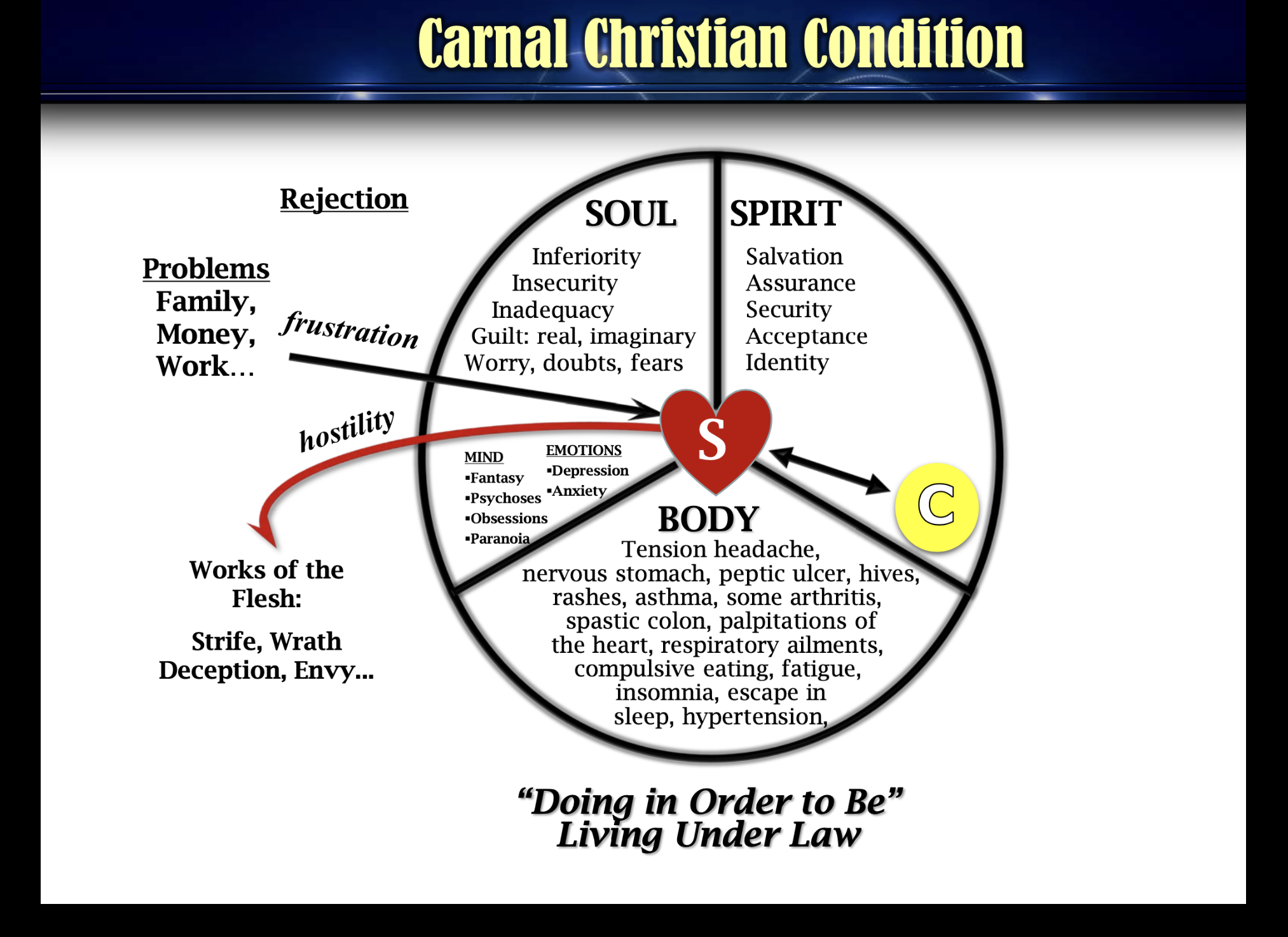
This diagram is sourced from Grace Fellowship International’s website. The original design is by Dr. Charles Solomon and updated by Dr. John Woodward. https://elcmatters.org/diagram-slides/#jp-carousel-3277
The Wheel is not Scripture.
It is not a complete explanation of temptation, emotion, or human behavior.
It cannot determine whether our interpretation of an event is true.
It does not replace careful biblical exegesis, pastoral wisdom, prayer, or dependence on the Holy Spirit.
Its value is diagnostic.
It can help us slow down a sequence that often happens very quickly.
An event occurs.
I assign meaning to it.
Desires become active.
Emotions and bodily reactions follow.
The flesh reaches for a familiar response.
In the dinner example, the event is straightforward:
Someone interrupts to correct a detail.
My mind quickly interprets the event:
“They have missed the point.”
“This correction was unnecessary.”
“They should have known not to interrupt here.”
A concern may be valid. But the interpretation can also gather exaggeration and judgment around it:
“Why do they always do this?”
Then desire becomes active.
I want to finish the story without interruption.
I want to be understood.
I want the other person to recognize that the correction was unhelpful.
None of those desires is automatically sinful.
The fleshly movement becomes clearer when the desire becomes ruling:
“I need this person to agree with my interpretation before I can become settled.”
The issue is no longer merely the interruption.
The issue is that I have made another person’s response responsible for my inner condition.
The flesh is not the body
In this discussion, the flesh does not mean the physical body.
The body belongs to God.
It is indwelt by the Spirit and destined for resurrection.
The flesh is the self-reliant pattern of living that seeks life, safety, control, approval, or peace apart from dependence on God.
In this example, the flesh may reach for control.
It may use an eye roll to communicate displeasure.
It may correct the person publicly.
It may withdraw from the conversation.
It may rehearse the event for the rest of the evening.
It may insist upon another conversation until the other person finally agrees.
The flesh says:
“I cannot be settled until I secure the response I want.”
The abiding life says:
“I can speak truthfully, but Christ is my life and the outcome belongs to the Father.”
A reasonable request can become a ruling demand
We should not resolve every conflict by telling ourselves that nothing important happened.
Perhaps the interruption was unhelpful.
Perhaps a pattern needs to be addressed.
Perhaps the relationship would benefit from a private conversation.
Biblical love does not require silence.
Ephesians 4 calls believers to speak the truth in love. Romans 12 itself calls for genuine love and honorable conduct.
A reasonable conversation may sound like this:
“When you interrupted the story to correct that detail, it disrupted what I was trying to communicate. Please allow me to finish the thought next time.”
That is not necessarily control.
The movement toward control occurs when I make the other person’s agreement the condition of my own rest.
Now I need them to say:
“You are right.”
“I should not have interrupted.”
“Your interpretation is the correct one.”
“I promise I will never do that again.”
If they misunderstand my concern, I feel wronged again.
If they respond defensively, the original frustration grows.
If they remember the event differently, I begin explaining more forcefully.
A legitimate desire for understanding has become an attempt to govern another person’s mind.
Renewal does not require abandoning the request.
It changes what I demand from the response.
The first reaction may remain
Transformation does not always begin with the disappearance of the first emotional reaction.
Frustration may still arise.
The thought “Why do they always do this?” may still appear.
That thought itself should be examined. The word “always” may already be overstating the situation. The sentence may contain impatience, self-importance, or an assumption about motive.
But the appearance of a familiar reaction does not prove that nothing has changed.
Growth can become visible in what follows.
Perhaps the frustration no longer controls my face.
I do not publicly correct the person.
I continue the story.
I remain present with the group.
Later, I speak privately and honestly.
If the person does not agree, I bring the unresolved concern to the Father.
The event no longer occupies the rest of the evening.
That is real change.
The first flash of frustration may remain, but the old pattern no longer carries the same authority.
Renewal is changing what happens next.
Restraint is real progress, but not the final goal
Outward restraint matters.
A restrained eye roll does not wound someone.
A sharp sentence left unspoken does not escalate the conversation.
Continuing the story rather than withdrawing preserves fellowship.
These are meaningful changes.
But the Christian life is more than managing outward behavior.
The deeper desire is to recognize Christ as my life while the frustration is first rising.
The inward response may be brief:
“Lord Jesus, You are my life here.”
“I want this person to understand and agree with me.”
“I can speak honestly, but I cannot produce the response.”
“By Your Spirit, express Your patience, truth, humility, and love through me.”
Then I continue the story.
Later, I may still have the private conversation.
Dependence does not silence the concern.
It changes the source from which I address it.
I am no longer entering the conversation to secure peace by producing agreement.
I am speaking truthfully while entrusting the outcome to the Father.
The Spirit renews through the Word
First Peter 5:7 says:
“Casting all your anxieties on him, because he cares for you.”
The sentence belongs to Peter’s call to humble ourselves under the mighty hand of God.
Casting care is an act of humility.
I acknowledge that I am not sovereign over the other person.
I cannot govern the mind, memory, motives, or response of another human being.
The Father can be trusted with what I cannot control.
That truth did not necessarily become a settled response the first time I read the verse. It became more deeply rooted as I returned to it, thought about it, prayed through it, and began applying it to unresolved situations.
The Spirit used the Word to change how I understood the moment.
The other person might not agree.
The concern might remain legitimate.
But I did not have to keep carrying the outcome.
This is more than replacing a negative phrase with a positive one.
It is learning to see the moment in light of the mercies of God.
The Father cares.
Christ is my life.
The Spirit dwells within me.
The other person belongs under God’s authority, not mine.
I am free to take the faithful step that belongs to me and release the result I cannot produce.
Union with Christ and the familiar pattern
The familiar pattern does not tell the believer who he is.
Romans 6 says the old self was crucified with Christ.
Romans 8 says the believer is no longer in the flesh as his defining realm but in the Spirit.
Colossians says his life is hidden with Christ in God.
The pattern may have been practiced for years.
It may still feel immediate.
Its familiarity may make it feel inevitable.
But familiarity is not identity.
The believer can say:
“This is the route my mind and body have often taken.”
He does not have to say:
“This is who I am.”
Christ is his life.
The Spirit is renewing him.
The pattern may return, but it does not possess the final word over what happens next.
This is who you are in Christ
If you are in Christ, you are not transforming yourself in order to earn mercy.
You have already received mercy.
You are not presenting your body to persuade God to accept you.
You are accepted in the Son.
You are not defined by the first reaction that appears.
Your life is hidden with Christ in God.
You are not required to deny legitimate concerns.
The Spirit leads you into truth and love.
You are not responsible for producing agreement inside another person.
You are responsible for speaking and acting faithfully before God.
You are not left to manufacture patience from yourself.
Christ is your life.
You are not condemned because an old pattern still feels familiar.
God is transforming you through the renewal of your mind.
You are not required to carry an unresolved outcome indefinitely.
The Father cares for you and invites you to place the care in His hands.
Part Two: The Living Picture
The Wagon Wheel and the Old Ruts
Imagine an old country road after years of wagon traffic.
Deep ruts have formed in the ground.
When another wagon enters the road, its wheels naturally fall into the same grooves. The ruts begin directing the wagon before the driver has made a conscious decision about every turn.
That is what a familiar response pattern can feel like.
The event occurs.
The wheel drops into the old track.
The mind assigns the familiar meaning.
The same desire becomes active.
The same emotional response follows.
The same behavior begins presenting itself as the obvious next step.
The depth of the rut helps explain why the response feels automatic.
But it does not mean the wagon has no other path.
In Christ, the believer is not condemned to travel the old route forever.
God has not merely shouted new instructions from the side of the road. He has joined us to His Son, given us His Spirit, and begun renewing the way we understand and respond.
The old rut may remain visible.
The wheel may still lean toward it.
But another way is now open.
The new way begins with mercy.
“I belong to Christ.”
It continues with truth.
“I may have a legitimate concern, but I cannot control another person’s response.”
It moves into dependence.
“Lord Jesus, You are my life here.”
Then it becomes embodied obedience.
I continue the conversation.
I speak privately.
I listen.
I make the request without demanding the result.
I cast the unresolved care upon the Father.
The old route was familiar.
The new path becomes increasingly familiar as the Spirit renews the mind through the Word.
The ruts do not define the traveler.
Christ does.
Part Three: The Grace-Formed Walk
Because This Is Who You Are, This Is How You Respond
Because you are in Christ, you can examine a familiar response without turning self-examination into condemnation.
The goal is not endless analysis.
The goal is to recognize where self-reliance entered, return to Christ as your life, and take the faithful step God has placed before you.
Tell the truth about what happened
Renewal does not require rewriting every difficult event into something pleasant.
The person may have interrupted.
The correction may have been unnecessary.
The flow of the story may have been disrupted.
Begin with what actually happened.
Avoid both exaggeration and denial.
“The person interrupted to correct a detail.”
That statement is different from:
“They always ruin my stories because they do not respect me.”
The first describes an event.
The second combines generalization, judgment, and an assumption about motive.
A renewed mind learns to distinguish what is known from what has been added.
Notice the meaning you assigned
Ask:
What did this event mean to me?
Perhaps it meant:
“They were not listening to the point.”
“They made me look foolish.”
“They do not value what I am saying.”
“I have lost control of the conversation.”
Some interpretation is unavoidable. People do not experience events without understanding them in some way.
The question is whether the interpretation agrees with truth.
Do I know the person’s motive?
Am I treating one event as an unchanging pattern?
Have I allowed a correct detail to make me feel personally diminished?
Have I decided that being misunderstood is intolerable?
The Spirit renews the mind by bringing our interpretations under the Word of God.
Identify what you want
Desire is not automatically sinful.
You may want to finish the story.
You may want the other person to understand your concern.
You may want a more considerate pattern in the relationship.
Those can be reasonable desires.
The more searching question is:
What happens inside me if I do not receive what I want?
Does disappointment become anger?
Does disagreement become a threat?
Does the other person’s lack of understanding become something I cannot release?
The desire has begun ruling when I make its fulfillment necessary for inner rest and faithful conduct.
Distinguish a request from control
A request honors the other person as someone responsible before God.
Control tries to secure the response.
A request says:
“Please hear what I am saying.”
Control says:
“You must understand this exactly as I do.”
A request says:
“Please do not interrupt the story this way in the future.”
Control says:
“I cannot become settled until you agree that I am right.”
A request leaves room for conversation.
Control needs a verdict.
The believer can speak honestly without making the other person responsible for his peace.
Turn toward Christ earlier
Perhaps you have already grown in outward restraint.
You no longer lash out.
You no longer withdraw.
You address concerns more privately.
Thank God for that work.
The next movement may be learning to turn toward Christ before the familiar interpretation gathers strength.
That turn may take only a moment:
“Lord Jesus, You are my life here.”
“I feel the frustration rising.”
“I want this person to agree with me.”
“Express Your truth and love through me.”
This is not a technique for forcing the frustration to disappear.
It is a conscious return to Christ as the source of the next response.
Present your body
Romans 12:1 keeps the application concrete.
Present your face.
Your tone.
Your eyes.
Your tongue.
Your posture.
Your decision to stay in the conversation.
Your willingness to listen.
Your next sentence.
You do not wait for the emotion to vanish before obedience becomes possible.
The body can be presented to God while frustration remains present.
That is one way the living sacrifice becomes visible.
Speak honestly without securing the outcome
Later, you may need to address the concern.
Speak plainly.
Describe the event without exaggeration.
Explain its effect.
Make the request.
Then listen.
The other person may understand.
The person may disagree.
They may remember the event differently.
They may respond well after some time.
Your responsibility is faithfulness, not control.
Romans 12:18 says:
“If possible, so far as it depends on you, live peaceably with all.”
Do what depends upon you.
Entrust what does not.
Cast the remaining care upon the Father
When the conversation ends without the result you hoped for, the old pattern may want to continue the discussion inwardly.
You replay the words.
You prepare better explanations.
You imagine future conversations.
You build a stronger case.
First Peter gives another response:
Cast the care upon Him because He cares for you.
You might say:
“Father, I have spoken as clearly as I know how. I entrust this person, this relationship, and the unresolved outcome to You.”
That prayer is not resignation.
It is humility under God’s mighty hand.
You are no longer pretending to govern what belongs to Him.
Measure growth by what happens next
We often measure transformation by the disappearance of the first reaction.
Sometimes that reaction does change over time.
But growth may also be visible in what follows.
How long does the frustration govern you?
Does it control your face?
Does it determine your words?
Does it ruin the evening?
Do you require another person’s agreement before you can return to the life in front of you?
How quickly do you remember Christ?
How quickly do you bring the interpretation under Scripture?
How quickly do you cast the unresolved care upon the Father?
The same reaction may still appear.
That does not mean nothing has changed.
Renewal changes what happens next.
When your response becomes sinful
There will be times when frustration becomes sinful anger, contempt, manipulation, withdrawal, or resentment.
When that happens, do not defend it merely because the original concern was legitimate.
A legitimate concern does not justify a sinful response.
Call the response what it is.
Confess it to the Father.
Ask forgiveness from the person you harmed.
Repair what can be repaired.
Then continue walking with Christ.
You do not have to punish yourself before returning to fellowship with God.
Christ has borne condemnation.
Repentance agrees with God, turns from sin, and takes the next faithful step under grace.
Receive help through the body of Christ
Some patterns are difficult to recognize from inside them.
A mature believer, pastor, mentor, or guide may help us see what we repeatedly miss.
Receiving help does not compete with dependence on Christ.
Christ often cares for His people through His body.
The goal is not to become dependent on another person’s interpretation. Every counsel must remain under Scripture.
But wise companionship can help us identify the old route, receive the truth, and practice honest dependence in real relationships.
The whole movement
The next time a familiar event activates a familiar response, you may remember this movement:
The event is real.
The interpretation should be examined.
The desire may be legitimate.
The demand should be surrendered.
The concern can be spoken.
The response cannot be controlled.
The remaining care belongs with the Father.
And Christ is your life through the whole encounter.
He is your life in the first moment of frustration.
He is your life in the private conversation.
He is your life when the conversation ends without the result you wanted.
You can live from Him in every part of the story.
For Deeper Reflection
What kind of event repeatedly produces the same response in you?
What meaning does your mind assign to that event?
Which part of your interpretation is clearly supported by what happened, and which part may involve assumption, exaggeration, or judgment?
What legitimate desire is present?
When does that desire begin functioning as a demand?
What response do you believe another person must give before you can become settled?
How does Romans 12:18 distinguish your responsibility from theirs?
Where has renewal already changed what happens next, even if the first reaction remains?
What embodied response needs to be presented to God?
Where might dependence on Christ move earlier in the sequence?
What unresolved concern do you need to cast upon the Father today?
A Prayer of Return
Father, thank You for the mercies You have given me in Christ.
Thank You that I do not have to transform myself in order to become acceptable to You. You have already received me in Your Son.
I present my body, mind, desires, words, and responses to You.
By Your Spirit, renew my mind through Your Word. Bring into the light the familiar meanings I assign to difficult moments and the responses I keep reaching for.
Keep me from pretending that real concerns do not matter. Keep me also from using those concerns to justify sharpness, withdrawal, manipulation, resentment, or control.
Lord Jesus, You are my life.
Express Your patience, truth, humility, and love through me.
Teach me to speak honestly, listen carefully, and make reasonable requests without demanding another person’s agreement as the condition of my peace.
When frustration rises, turn my attention toward You.
When a conversation remains unresolved, teach me to cast the care upon the Father and continue walking with You.
Thank You that the familiar pattern is not my identity and does not have to decide what happens next.
In Jesus’ name, amen.
Scripture Trail for Further Study
Romans 1:16–17
Romans 3:21–26
Romans 5:1–11
Romans 6:1–14
Romans 8:1–39
Romans 12:1–21
John 15:1–11
Galatians 2:20
Galatians 5:13–26
Philippians 2:12–13
Colossians 3:1–17
Ephesians 4:20–32
2 Corinthians 3:17–18
1 Peter 5:5–11
James 1:19–25
Proverbs 15:1–4
Proverbs 18:2, 13, 17